Tag: tricks

  • The OEM vs. Aftermarket Strategy: Expert Advice from 4 Seasons

    The OEM vs. Aftermarket Strategy: Expert Advice from 4 Seasons

    How to Handle the “Parts Conversation” with Your Insurance Adjuster

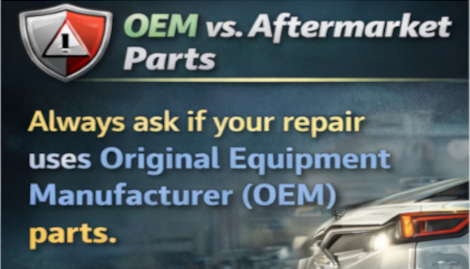
    When the insurance company sends you an estimate, it often feels like a foreign language. One of the biggest decisions you’ll face is whether to use OEM (Original Equipment Manufacturer) or Aftermarket parts. Here is how to navigate that choice like a pro.

    Tip 1: Read the Fine Print on Your Policy

    Check if your insurance policy has an “OEM Endorsement.” Some policies guarantee original parts for the first few years of a car’s life. If you have it, insist on it!

    Tip 2: Prioritize “Safety-Critical” Components

    If the repair involves your airbags, sensors, or structural pillars, do not compromise. Demand OEM. These parts are designed to work with your car’s specific computer system and crash-test ratings. Aftermarket “safety” parts are rarely tested to the same rigorous standards.

    Tip 3: Think About the Finish

    Aftermarket fenders or hoods are often made with different grades of steel or aluminum. Over time, these parts may rust differently or the paint may fade at a different rate than the rest of your car. If you plan on keeping the car for more than 2 years, OEM is the only way to ensure the paint matches long-term.

    Tip 4: Ask About “CAPA Certified”

    If your insurance insists on aftermarket parts to save costs, ask if they are CAPA Certified. This means a third party has tested the part for fit and finish. It’s better than “no-name” parts, though still not as perfect as OEM.

    Tip 5: Protect Your Resale Value

    If you are leasing your vehicle or plan to trade it in soon, aftermarket parts can result in “diminished value.” Dealerships can often tell when a car has been repaired with non-factory parts and will offer you less for your trade-in.

    What is CAPA?

    CAPA stands for the Certified Automotive Parts Association. It is a non-profit organization that acts as a “watchdog” for the collision industry.

    CAPA vs. Regular Aftermarket

    • Regular Aftermarket: These parts are made by third-party companies with almost no oversight. They might look like the original part, but the metal could be thinner, the plastic might be more brittle, or the holes might not line up during installation.
    • CAPA Certified: These are still aftermarket parts (not made by the car manufacturer), but they have been tested by CAPA to prove they are functionally equivalent to the original. They check for:
      • Fit: Does it bolt on without a gap?
      • Material: Is the steel or plastic the same strength as the original?
      • Safety: In a crash, will it fold and crumple the same way as the factory part?
  • The “Hidden” Damage Guide: Expert Advice from 4 Seasons

    The “Hidden” Damage Guide: Expert Advice from 4 Seasons

    5 Things to Check After a Fender Bender (That You Can’t See from the Outside)

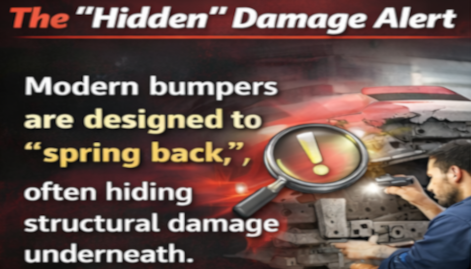
    Most drivers walk around their car, see a few scratches on the plastic bumper, and breathe a sigh of relief. But at 4 Seasons Collision Center, we’ve seen “minor” taps hide major structural issues. Here is your post-accident checklist for hidden damage.

    1. Check Your Panel Gaps

    Walk around the car and look at the gaps between the doors, hood, and trunk. Are they uniform? If one side is tighter than the other, your frame or unibody may have shifted, even if the bumper looks fine.

    2. Test Your Technology

    Modern bumpers are “smart.” If your car has parking sensors or blind-spot monitoring, test them immediately. A slight jar can knock these sensors out of calibration. If your “blind spot” light stays on or doesn’t trigger, you have hidden electronic damage.

    3. Look for “Fluid Trails”

    Check the pavement where you were parked. A small impact can crack a radiator support or a pressurized AC line. If you see neon green, pink, or clear oily spots, your car shouldn’t be driven long distances.

    4. Listen for New Noises

    Turn off the radio and drive slowly in a quiet area. Squeaks, rattles, or a “rubbing” sound when you turn the wheel often indicate that a liner or a structural brace has been pushed into a tire or suspension component.

    5. The “Trunk Test”

    Open and close your trunk and all doors. If they require more force than usual or make a “metallic” clicking sound, the impact energy traveled through the frame.

    Pro Tip: Never settle for a “visual estimate” over the phone. A professional body shop will perform a “teardown” to see what’s happening behind the plastic.

  • The Right to Repair: Expert Advice from 4 Seasons

    The Right to Repair: Expert Advice from 4 Seasons

    Keep your vehicle safe, preserve its resale value, and navigate the aftermath of an accident with these professional insights.

    1. The “Right to Repair” Rule

    Many drivers don’t realize that in North Carolina, you have the legal right to choose where your vehicle is repaired. Your insurance company may “steer” you toward a specific network shop, but the choice is entirely yours. Choosing a local, independent expert ensures your car is repaired to factory standards, not just insurance minimums.

    2. Immediate Post-Accident Steps

    If you’re involved in a fender bender in Gastonia, safety comes first. Once you are in a safe location:

    • Document Everything: Take wide-angle and close-up photos of the damage and the surrounding scene.
    • Check for Hidden Damage: Even a low-speed “tap” can compromise sensor calibration or bumper reinforcement bars.
    • Avoid “DIY” Touch-ups: Using hardware store spray paint on a modern vehicle can lead to rust or peeling, costing more to strip and fix later.

    3. Protecting Your Paint in NC Humidity

    Our local climate can be tough on automotive finishes. To prevent oxidation and clear-coat failure:

    • Wash Weekly: Remove bird droppings and tree sap immediately, as these are acidic and can “etch” into your paint within 48 hours.
    • The Wax Test: If water doesn’t bead on your hood, your paint is unprotected. A high-quality sealant or wax acts as a sacrificial barrier against UV rays.

    4. Navigating the Claims Process

    When filing a claim, ask your estimator if they are using OEM (Original Equipment Manufacturer) parts or Aftermarket parts. While aftermarket parts can be cheaper, OEM parts ensure a perfect fit and maintain your vehicle’s structural integrity as designed by the manufacturer.