

How to Handle the "Parts Conversation" with Your Insurance Adjuster
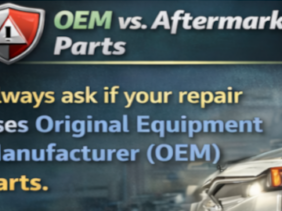
When the insurance company sends you an estimate, it often feels like a foreign language. One of the biggest decisions you’ll face is whether to use OEM (Original Equipment Manufacturer) or Aftermarket parts. Here is how to navigate that choice like a pro.
Tip 1: Read the Fine Print on Your Policy
Check if your insurance policy has an "OEM Endorsement." Some policies guarantee original parts for the first few years of a car's life. If you have it, insist on it!
Tip 2: Prioritize "Safety-Critical" Components
If the repair involves your airbags, sensors, or structural pillars, do not compromise. Demand OEM. These parts are designed to work with your car’s specific computer system and crash-test ratings. Aftermarket "safety" parts are rarely tested to the same rigorous standards.
Tip 3: Think About the Finish
Aftermarket fenders or hoods are often made with different grades of steel or aluminum. Over time, these parts may rust differently or the paint may fade at a different rate than the rest of your car. If you plan on keeping the car for more than 2 years, OEM is the only way to ensure the paint matches long-term.
Tip 4: Ask About "CAPA Certified"
If your insurance insists on aftermarket parts to save costs, ask if they are CAPA Certified. This means a third party has tested the part for fit and finish. It’s better than "no-name" parts, though still not as perfect as OEM.
Tip 5: Protect Your Resale Value
If you are leasing your vehicle or plan to trade it in soon, aftermarket parts can result in "diminished value." Dealerships can often tell when a car has been repaired with non-factory parts and will offer you less for your trade-in.
What is CAPA?
CAPA stands for the Certified Automotive Parts Association. It is a non-profit organization that acts as a "watchdog" for the collision industry.
CAPA vs. Regular Aftermarket
- Regular Aftermarket: These parts are made by third-party companies with almost no oversight. They might look like the original part, but the metal could be thinner, the plastic might be more brittle, or the holes might not line up during installation.
- CAPA Certified: These are still aftermarket parts (not made by the car manufacturer), but they have been tested by CAPA to prove they are functionally equivalent to the original. They check for:
- Fit: Does it bolt on without a gap?
- Material: Is the steel or plastic the same strength as the original?
- Safety: In a crash, will it fold and crumple the same way as the factory part?